Distillation splits two substances by boiling point. In a commercial distillery, the goal is straightforward: separate the alcohol produced during fermentation and concentrate it to a workable proof. A fermented wash sitting at 10% ABV comes in; a spirit at 60-70% ABV or higher comes out. How you get there depends on which technology you choose and that choice shapes everything about what ends up in the bottle.
Prodeb supplies both. A pot still for batch runs where flavour is the priority. A column still for continuous rectification where neutral, high proof spirit is the target. And for distilleries that need both, a hybrid configuration where a pot still feeds directly into an adjacent distillation column.
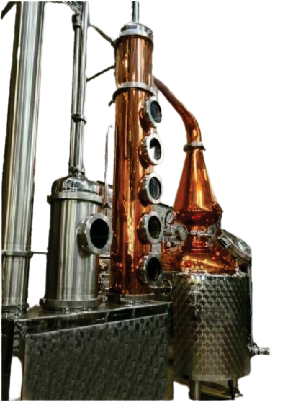
Pot Still vs Column Still Distillation: A Technical Comparison
A pot still is a batch vessel. You charge it, heat it, draw the spirit over the lyne arm, and repeat. Each run carries congeners - esters, furans, heavier alcohols - from the wash into the distillate. That's not a defect. For whisky and rum, those congeners are the product. Copper surface contact in the pot still head and neck reacts with sulphur compounds in the vapour, removing the worst of them while leaving the flavour compounds largely intact.
The ABV ceiling on a single pot still run is around 65-70%, depending on wash strength and cut points. To reach drinking strength, the spirit goes back into the still for a second run (sometimes a third). The stillman controls the cut - fore shots, heart, feints - manually or with automated valves, dialling the spirit character based on temperature and flow.
A column still works continuously. Wash enters mid column; steam or indirect heat rises from below. Each tray in the column acts as a theoretical plate, enriching vapour concentration at every stage. A well designed distillation column running 20+ theoretical plates can produce neutral spirit above 95% ABV in a single pass. Add a reflux condenser at the top which recondenses the heavier vapour fractions and returns them to the column and alcohol purity climbs further.
The operational difference matters when you're deciding what to build. A pot still distillation setup suits artisan runs of 500-2,000 litres. A column still distillation system handles continuous throughput measured in thousands of litres per hour, which is why vodka and neutral grain spirit plants rely on it.
Key Features of Prodeb's Distillation System
Copper Construction and Sulphur Removal
Prodeb fabricates pot still heads, lyne arms, and neck sections from high grade copper. Copper doesn't just look traditional it catalyses the reaction between dimethyl trisulphide and copper oxide, pulling sulphur from the vapour. How much this happens depends on the copper to volume ratio of the still. Taller, skinnier stills that have a greater amount of copper surface exposure yield lighter and more floral distillates, while shorter, fatter pot stills hold onto heavier elements.
Column Tray Design and Efficiency
Prodeb's distillation machinery uses sieve trays and bubble cap trays depending on throughput and the desired vapour liquid equilibrium. Bubble cap trays maintain a liquid seal at low vapour velocities, which keeps rectification stable across variable feed rates. Sieve trays are more efficient at high throughput but require tighter feed control. For most craft distillery distillation plant configurations, a combination of the two gives flexibility without sacrificing efficiency.
Reflux Condensers
Reflux condenser is located at the head of the column. The process involves condensation of vapour containing significant amounts of water which is then refluxed into the distillation column and thereby enriches alcohol content going up the column. The reflux ratio can be adjusted by controlling the coolant flow in the reflux condenser.
Heating Options
Prodeb builds pot still and column still vessels for both steam jacket heating and electric immersion elements. Steam jacket systems use an external boiler to generate steam, which flows through the outer walls of the still. Uniform heat transfer is critical to avoid hot spot scorching of the wash. For that reason, most distillation equipment Prodeb supplies for mash based washes includes an agitator: a low speed gear motor driving a three bladed paddle. It prevents particulates from settling, keeps temperature even, and significantly reduces the risk of scorching in uncleared washes.
CIP Cleaning
Every distillation plant configuration Prodeb supplies can include a CIP (Clean in Place) system. This circulates cleaning solution through every vessel, pipe, condenser, and valve automatically between production runs, without disassembly. For multi product distilleries running whisky, rum, and vodka from the same distillation equipment, carryover contamination is a real operational problem. CIP eliminates it.
Applications of Prodeb Distillation Equipment
Whisky and rum are the core applications for a pot still. Both spirits rely on congener carryover for their flavour profile. Scotch distilleries typically run a wash still followed by a spirit still two pot still distillation in sequence. Rum distillers often use a single pot still with a dephlegmator (partial condenser) to control copper contact and reflux in one vessel.
Vodka and neutral grain spirit require a column still. The objective is the opposite of whisky: strip out everything except ethanol. A properly designed distillation column can achieve 96.4% ABV, the azeotropic limit of ethanol water under standard atmospheric pressure. Prodeb's column still systems are designed to approach that threshold reliably across production shifts.
Brandy and grappa sit in the middle. Many European distillers run brandy through a single pot still distillation pass to preserve fruit esters, then redistil the low wines in a column with controlled reflux to clean the spirit without stripping it entirely.
Hybrid configurations connect a pot still directly to a distillation column. The pot still handles the initial stripping run; the column takes the low wines and rectifies them to a higher ABV than the pot alone could achieve. This layout is gaining traction in distilleries that want the production rate benefits of column rectification without losing the character contributions of copper pot still contact.
Benefits of Prodeb's Distillation Systems
Flavour Control
Both pot still distillation and column still operation give distillers active control over flavour. On the pot still side, cut timing and reflux dephlegmator settings determine how much of the heavy oil fraction reaches the final spirit. On the column side, adjusting the reflux ratio and draw off point changes the congener profile of the output. Prodeb's automation interfaces allow repeatable setpoints so a master distiller can document a specific flavour target and reproduce it consistently at scale.
Energy Efficiency
Heat recovery is built into every distillation machinery configuration Prodeb supplies. Condenser cooling water exits the system at elevated temperature and can be routed back to preheat incoming wash. On a continuous column still distillation run, this heat integration reduces steam consumption by 20-35%, depending on feed temperature and throughput volume.
Scalability
Prodeb designs distillation plant systems from 200 litre pilot pot still units up to full industrial column still installations running 5,000+ litres per hour. The same engineering standards apply at every scale: food grade stainless steel 316L fabrication for all vessels, TIG welded seams, and copper internals where vapour contact is required.
Why Choose Prodeb for Distillation Equipment
Prodeb has designed and installed distillation machinery for commercial distilleries producing whisky, rum, vodka, brandy, and craft gin. Their engineering process starts with mash bill and wash chemistry analysis because what goes into a pot still distillation system determines what that system needs to do. Vessel geometry, copper surface area, tray count, and reflux configuration all flow from that initial specification.
Every distillation plant Prodeb delivers is CAD designed, fabricated to food industry standards, and commissioned on site. The column still calibration process includes a full vapour liquid equilibrium test run to verify that the system is hitting design ABV and congener targets before handover.
For distilleries investing in a single artisan pot still or a complete multi stage rectification plant, Prodeb's team provides the engineering documentation, operator training, and post commissioning support that keeps production running.
Methodology
Prodeb's project sequence for distillation system builds:
- Mash bill analysis: determining wash composition, fermentable solids content, and the sulphur precursor load that the copper pot still contact needs to address.
- CAD vessel design: pot still geometry, column height and diameter, tray spacing, and condenser sizing, calculated against target throughput and output ABV.
- Fabrication: stainless steel 316L vessel bodies, copper head and neck sections, welded according to PED (Pressure Equipment Directive) standards where applicable.
- Assembly and instrumentation: temperature probes, pressure gauges, automated valve actuators, and PLC interfaces installed and tested before site delivery.
- Commissioning: a water run test of all distillation machinery systems, followed by a live production run with Prodeb engineers on site to verify cut points, reflux ratios, and CIP cycle completion.
Frequently Asked Questions
1. How often does a pot still require maintenance?
Under normal production conditions, a copper pot still needs a visual inspection of seams and fittings every 3-6 months. CIP cycling after every run handles most internal cleaning. Copper oxidation on pot still heads and lyne arms is cosmetic and does not affect performance. Full copper replating or section replacement is typically required after 10-15 years of continuous use.
2. How do I scale production in a distillation plant?
The most practical approach is to add a second pot still in parallel for batch volume, or to introduce a column still alongside an existing pot still for continuous throughput. Prodeb designs distillation plant configurations with expansion in mind common manifolds and shared condenser loops reduce the cost of adding capacity later.
3. What are the operational differences between a pot still and a column still?
A pot still is a batch operation: charge, run, drain, repeat. A column still runs continuously as long as wash feed and heat are maintained. Pot still distillation requires active management of cut timing. Column still operation requires monitoring of feed rate, steam pressure, and reflux ratio. Both require temperature logging throughout the run.
4. Does copper matter in a column still, or only in a pot still?
Copper contact matters in both. In a pot still, the copper head and lyne arm handle sulphur removal. In a column still distillation system, copper packing or copper bubble cap trays perform the same catalytic role. Prodeb specifies copper internals in the sections of their column still distillation systems where sulphur removal is critical to spirit quality.
5. Why does pot still distillation produce better flavour retention than column rectification?
A pot still is not designed to strip congeners it's designed to carry them through selectively. The partial reflux, lower ABV output, and copper contact create conditions where flavour compounds co-distil with the alcohol fraction. Column still rectification, by design, removes those compounds in pursuit of purity. For whisky and rum, that's the wrong result. Which is why Prodeb's hybrid pot still/column still configurations let distillers run the same wash two ways for different product lines.