Cold Stabilization & Blending: Prodeb's Precision Chill Proofing Solutions
What Is Cold Stabilization in Distilled Spirits?
When a distiller finishes a run, the spirit looks clean inside the still. Lower the temperature pour it over ice, let the bottle sit in a cold fridge and something changes. Cloudiness forms. Floaters appear. The product that looked pristine at 20°C now looks questionable at 4°C.
Cold stabilization is the deliberate application of sub-zero temperatures to a finished spirit before bottling, forcing non soluble compounds out of suspension while the liquid is still in a controlled vessel. Long chain fatty acid esters, certain proteins, waxy congeners these stay dissolved at room temperature but precipitate when temperature drops. If producers don't address them in the tank, they'll appear in the bottle.
The technique borrows directly from winemaking. The cold stabilization wine process has used controlled chilling to drop potassium bitartrate crystals for decades. Spirit producers selling into cold climate markets adopted the same logic: handle cold stabilization at the facility, not after bottling.
The mechanism is nucleation-and-precipitation. When temperature drops below a compound's solubility threshold, molecules aggregate around nucleation sites and fall out of solution. A well designed stabilization tank holds the spirit at target temperature long enough for that precipitation to complete typically between -5°C and -10°C for 24 to 72 hours, depending on spirit type and dilution level.
Benefits of Cold Stabilization for Spirit Quality
The obvious benefit is visual. A bottle that stays clear under refrigeration looks like a quality product.
But the process does more than protect appearance.
Fatty acid ethyl esters the compounds most responsible for chill haze in diluted spirits also carry off notes. Ethyl palmitate and ethyl oleate contribute oily, waxy mouthfeel characteristics that can flatten the mid palate of a vodka or make a blended whiskey taste heavier than intended. Removing them can sharpen the flavour profile, not just the appearance.
This is why the cold stabilization wine process maps directly onto spirit production. Both industries found that the compounds causing visual instability at low temperatures also tend to muddy flavour. Wine producers treat tartrate precipitation as a quality step, not a cosmetic one. Spirit producers are learning the same lesson.
Precision matters here. A vessel that holds temperature inconsistently warming by two or three degrees during a long hold may not complete precipitation. Compounds that partially nucleate but don't fully settle pass through even fine pore filtration. The product clears temporarily but clouds again later. This is why glycol jacket systems with tight PID control matter.
Properly chill proofed spirits also show fewer changes over extended storage less flavour drift and more consistent appearance at point of sale.
The Operational Flow: Before Filtration and Bottling
Sequence matters. The treatment happens before filtration, not after.
Filtration removes particles already in suspension. But fatty acid esters and chill haze compounds are not particles at room temperature they're dissolved. Run the spirit through a polish filter at 20°C and it passes cleanly. Lower the temperature later and precipitation happens downstream, where nothing can catch it.
The correct sequence: chill in a stabilization tank to target temperature, hold until precipitation is complete, then filter cold to remove the precipitate before warming back to bottling temperature.
This is standard practice and applies equally to spirits. The vessel acts as a controlled precipitation chamber. Jacketed sidewalls circulate chilled glycol to bring the entire liquid mass to target temperature without warm spots. An agitator speeds initial cooling but is typically stopped during the hold, allowing precipitates to settle.
Engineers familiar with german tank stabilization beer methodology will recognize this as analogous to the lagering step extended cold holds in jacketed vessels that stabilize protein tannin complexes and haze precursors. German tank stabilization beer equipment has set the benchmark for jacketed vessel temperature uniformity and glycol efficiency that modern spirit vessel design draws from directly.
Applications Across the Spirits Category
Spirit type dictates the cold cold stabilization approach, but the underlying discipline applies broadly.
- Vodka is the most demanding case. Produced for visual clarity above almost everything else, and typically consumed cold or in iced cocktails, vodka reaches the consumer under exactly the conditions that trigger chill haze.
- Whiskey requires more nuance. Blended expressions and export-focused brands typically apply the treatment to ensure visual consistency across destination markets with different temperature profiles.
- Gin and flavoured spirits face a specific challenge: botanical oils and flavour active compounds that define the product can also be chill haze precursors. Temperature calibration matters too aggressive strips flavour; too conservative leaves visual instability in place.
This parallels decisions winemakers make for aromatic varieties. Wine producers working with high terpene grapes set chilling targets that drop tartrate crystals without stripping aromatics. Gin producers face the same trade off.
The cold stabilization wine industry's decades of experience is one reason spirit producers have increasingly borrowed its equipment and methods. German tank stabilization beer producers have contributed equally their engineering standards for temperature uniformity, glycol efficiency, and sanitary construction set performance benchmarks that now inform spirit processing vessel design. Where german tank stabilization beer demands consistent cold conditioning at scale, spirit processing demands the same discipline.
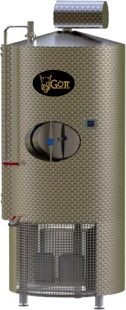
Prodeb Cold Stabilizer Blending Tanks
After distilling, the spirit moves to Prodeb's Cold Stabiliser and Blending Tanks designed to stabilize temperature, accept flavouring agents, and prepare the liquid for filtration and packaging. The design reflects what producers actually need.
- Temperature precision: Prodeb's units run a digital controller with an intuitive display for setting exact temperature targets. The glycol jacket maintains uniformity across the vessel, not just at the sensor point. Partial chilling produces partial precipitation the entire liquid mass needs to reach target temperature for cold stabilization to work reliably.
- Blending capability: Both operations happen in the same vessel. The controller supports multiple agitator mixing programs, so flavouring agents can be introduced and blended before the cold hold without transferring to a separate tank.
- Sanitary construction: Like Prodeb's fermentation vessels, these tanks carry a mirror like type 8B polish finish, supporting CIP cleaning without residue accumulation.
- Oil removal option: An optional filter removes oils that cause haziness in diluted spirits, adding a mechanical stage after the hold to capture remaining suspended compounds.
For producers meeting the precision standards of the wine industry and german tank stabilization beer engineering, Prodeb's vessel delivers the temperature control, hygienic construction, and operational reliability those benchmarks require.
Frequently Asked Questions
1. How long should a spirit remain in a stabilization tank?
Hold time for cold stabilization depends on spirit type, alcohol strength, and target temperature. A vodka diluted to 40% ABV typically needs 24 to 48 hours at -5°C to -8°C for precipitation to complete. Higher proof spirits may require longer holds because some compounds remain soluble at higher alcohol concentrations. Prodeb's digital controller lets operators program specific hold durations for consistent results.
2. Why does the cold stabilization wine process influence modern distilling?
Wine producers have managed this at industrial scale for decades, developing the jacketed vessels, CIP compatible surfaces, and accurate temperature sensing systems that the process requires. When spirit producers encountered the same chill haze problems, the cold stabilization wine process provided a ready framework equipment designs and operational parameters that carried over directly.
3. How does this prevent haze in high proof spirits specifically?
At high alcohol concentrations, long chain fatty acid esters stay dissolved at temperatures that would precipitate them from a lower proof liquid. When a cask strength spirit is diluted at the distillery or by a consumer adding water those solubility conditions change. Treating the spirit at intended bottling strength forces precipitation in the stabilization tank, where filtration can remove it before the product is packed.
4. What separates Prodeb's equipment from standard chilling vessels?
Precise digital temperature control, multi program agitation, and the type 8B interior finish. Standard chilling vessels manage temperature at the jacket surface. Prodeb's design targets uniformity throughout the vessel volume. Partial chilling produces partial precipitation which is worse than none, because partially nucleated compounds behave unpredictably downstream.
5. Can the same stabilization tank handle both wine and spirit production?
Yes. Prodeb's Cold Stabilizer Blending Tanks are built to the standards required by both wine and spirit producers. The programmable controller accommodates different products without equipment changeover, making the same vessel practical for cold stabilization wine process runs and spirit chill proofing within the same facility.