What Is Mashing and Lautering?
Grain based spirits begin their journey in one place: the mash tun. Before fermentation, before distillation, before any flavour compound develops in a cask, the raw starch locked inside barley, corn, rye, or wheat must be converted into fermentable sugar and then separated cleanly from the spent grain bed. That two stage process is mashing and lautering, and it is the most enzymatically sensitive phase in grain spirit or beer production.
During mashing, grist is hydrated and held at controlled temperatures typically between 62°C and 72°C for barley malt to activate the alpha and beta amylase enzymes that cleave starch chains into maltose and glucose. The window is narrow. Drop below 60°C and enzyme activity stalls. Push above 78°C and those enzymes denature permanently. A degree or two of drift, sustained over a 45 minute rest, can shift fermentable sugar yield by several percentage points across an entire brew season. This is why the thermal behaviour of the mash and lauter tun matters as much as its geometry.
The clarity of the collected wort, the speed of runoff, and the efficiency of sparge water distribution across that bed are all mechanical problems problem that the engineering of your mash lauter tun either solves or compounds. A poorly designed system leaves extract behind. A well engineered one recovers 94% to 97% of available sugars with consistent turbidity across every runoff.
For any operation producing whisky, vodka, grain neutral spirit, or craft beer at scale, mashing and lautering is not a preliminary step. It is the step.
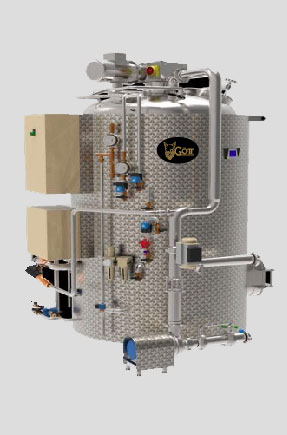
Characteristics of Prodeb Mashing and Lautering Equipment
Prodeb's approach to mashing and lautering equipment comes from over two decades of direct fieldwork across distillery and brewery installations on multiple continents. The engineering priorities are consistent: maximize extract recovery, maintain thermal precision, and build vessels that perform identically on batch 1 and batch 10,000.
Every Prodeb mash and lauter tun is fabricated from certified SS304 stainless steel, with full penetration internal welds and a polished finish that eliminates crevices where grain solids or biological material can accumulate between cleaning cycles. The external finish follows the same standard not for aesthetics, but because rough weld seams on tank exteriors accelerate corrosion under insulation.
Thermal stability is built in through full encirclement steam jackets on the mash vessel. These jackets maintain mash temperature during extended protein rests or step mashing programs without the localized scorching risk of internal heating elements. For multi step mashing common in high adjunct distillery mash bills and decoction style brewery schedules PLC controlled temperature ramping holds each rest within +0.5°C of target, logged automatically for quality records.
Multiple collection chambers beneath the false bottom allow the first cloudy wort fractions to be routed separately for recirculation, while clear wort is collected immediately in the correct vessel. This prevents turbid runoff from diluting the primary collection and improves downstream performance in the whirlpool.
Key Features of Prodeb Mashing and Lautering Equipment
Variable Speed Rake and Knife Drive
The spent grain bed is not homogeneous. As lautering progresses, the upper grain layer compacts under its own weight and the weight of sparge water above it. Prodeb's automated rake and knife assembly addresses this directly. The rake depth, rotation speed, and knife angle are all independently adjustable through the PLC interface, allowing operators to cut into compacted zones and restore permeability without disturbing the bed geometry below.
Grist Hydration System
Dry grist entering a mash tun without proper pre hydration forms clumps that resist enzymatic penetration. Prodeb's grist hydration design wets the incoming grain on top of the mashing vessel before it contacts the mash liquor, ensuring even water distribution through the grist column from the moment contact begins. This alone improves extract efficiency on coarsely milled malt by 1% to 2% small in percentage terms, significant across annual production volume.
Specialized Sparging Nozzle
Sparge water must be distributed across the full surface of the grain bed without disturbing the filter layer beneath. Prodeb's sparging nozzle geometry produces a low velocity, even spray pattern calibrated to the vessel diameter. Channelling where sparge water cuts a path through the grain rather than washing evenly through it accounts for a large share of extract loss in inferior lauter mash tun designs.
Protein and Trub Separation
Prodeb's mashing and lautering systems are engineered to promote early protein separation. The tank geometry, combined with controlled turbulence during mashing, concentrates unwanted proteins into a well defined trub layer that transfers cleanly to the whirlpool. This reduces fining requirements downstream and contributes to a cleaner fermentation profile.
CIP Integration
Every Prodeb mash and lauter tun ships with full CIP (clean in place) circuit integration. Cleaning is programmed into the same PLC that controls the mash schedule, so no manual intervention is required between batches beyond verification. For high throughput brewery equipment manufacturer installations running two or three brews per day, this is not a convenience feature it is a production capacity enabler.
Why Choose Prodeb Mashing and Lautering Equipment?
Prodeb's position as a brewery equipment manufacturer is built on a specific claim: that our mashing and lautering technology delivers higher extract recovery, faster runoff, and lower oxygen pickup than comparable systems at the same price point. That claim is verifiable in installation data.
The distillery machinery category is crowded with vessels that handle the basic task hydrating grain, holding temperature, draining wort but diverge sharply on precision and consistency under production pressure. A lauter mash tun that performs well on a 10 hectolitre pilot batch can degrade significantly on the same recipe at 50 hectolitres if the false bottom geometry, rake drive torque, or jacket uniformity wasn't designed for scale. Prodeb's systems are engineered from the outset for the production volumes our clients actually operate.
Flavour consistency across a full product range depends on process consistency at mashing and lautering. Batch to batch variation in extract efficiency translates directly into variation in original gravity, which compounds through fermentation and maturation. Prodeb's systems make that variation controllable.
Frequently Asked Questions
1: How do I optimize runoff speed in a mash lauter tun without increasing wort turbidity?
Runoff speed is a function of bed permeability and hydraulic head. The fastest way to increase speed without pulling grain fines into the wort is to manage bed depth and rake action together. Prodeb's mash lauter tun designs allow variable rake speed during runoff slower at the start of the cut to avoid disturbing the filter cake, faster once the bed has re settled.
2: What does maintenance look like on a high efficiency lauter mash tun?
Daily: CIP after every brew, with caustic wash followed by acid rinse and hot water flush. Weekly: manual inspection of false bottom plates for deformation or blocked slots, rake arm alignment check, and nozzle inspection. Quarterly: full disassembly of the rake drive assembly for bearing inspection. Prodeb's lauter mash tun designs place all wear components seals, rake drive bearings, nozzle heads at accessible points to reduce maintenance time.
3: How does Prodeb distillery machinery compare to standard fabricated tanks?
Standard fabricated tanks are designed to hold liquid. Prodeb's distillery machinery is designed to control a process. The differences show up in jacket uniformity (standard tanks often have hot spots), false bottom geometry (generic perforated plate versus engineered slot distribution), and PLC integration (manual valves versus automated program control). For high volume mashing and lautering operations, the performance gap compounds across every batch.
4: What makes Prodeb a reliable brewery equipment manufacturer for complex mash bills?
Complex mash bills high adjunct distillery recipes, mixed grain craft beer grists, heavily modified malts stress lautering systems in ways that simple single malt schedules don't. Corn and unsalted adjuncts lack the husk structure that makes barley lauter easily, which means the mechanical contribution of the rake and knife system becomes critical. Prodeb's experience as a brewery equipment manufacturer specifically includes high adjunct installations, and our equipment specifications reflect that.
5: What extract recovery rates can I expect from Prodeb mashing and lautering systems?
On well modified malt with appropriate mill gap settings and water chemistry, Prodeb systems consistently achieve 94% to 97% lauter efficiency. On high adjunct distillery mash bills with 30% to 50% un malted grain, efficiency depends more on mash temperature profile and enzyme addition rates, but Prodeb's wider lautering bed and controlled rake geometry mean mechanical losses stay well below industry average.